
Meet the Harvester x Eli Gladstone
Eli Gladstone is from a small Haida community called Skidegate in Haida Gwaii, BC and has been trapping green crabs since their introduction to the archipelago. He's currently looking to identify long-term solutions to support continued trapping, and believes finding a viable market is the most promising pathway to achieving this.
In June of 2026, Eli and trapping partner Linden McDiarmid made the long journey to Portland, Maine, to share their story on the invasive with attendees of the Green Crab Working Summit, connect with green crabbers across the East Coast, and learn more about New England markets. After the summit, we had a chance to chat with Eli about his experience as a green crabber and what’s needed to support trapping and market efforts on Haida Gwaii.
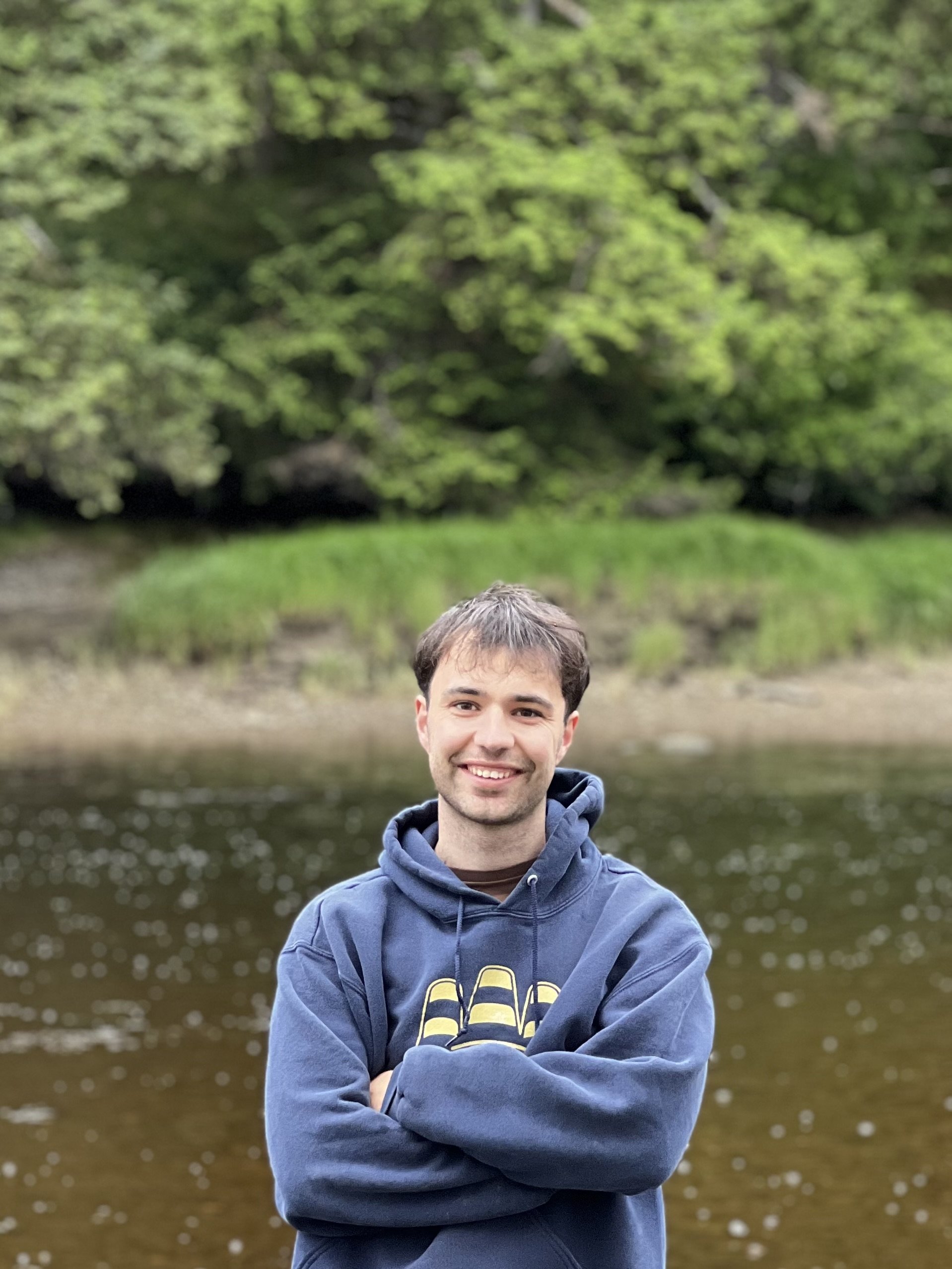
Eli Gladstone
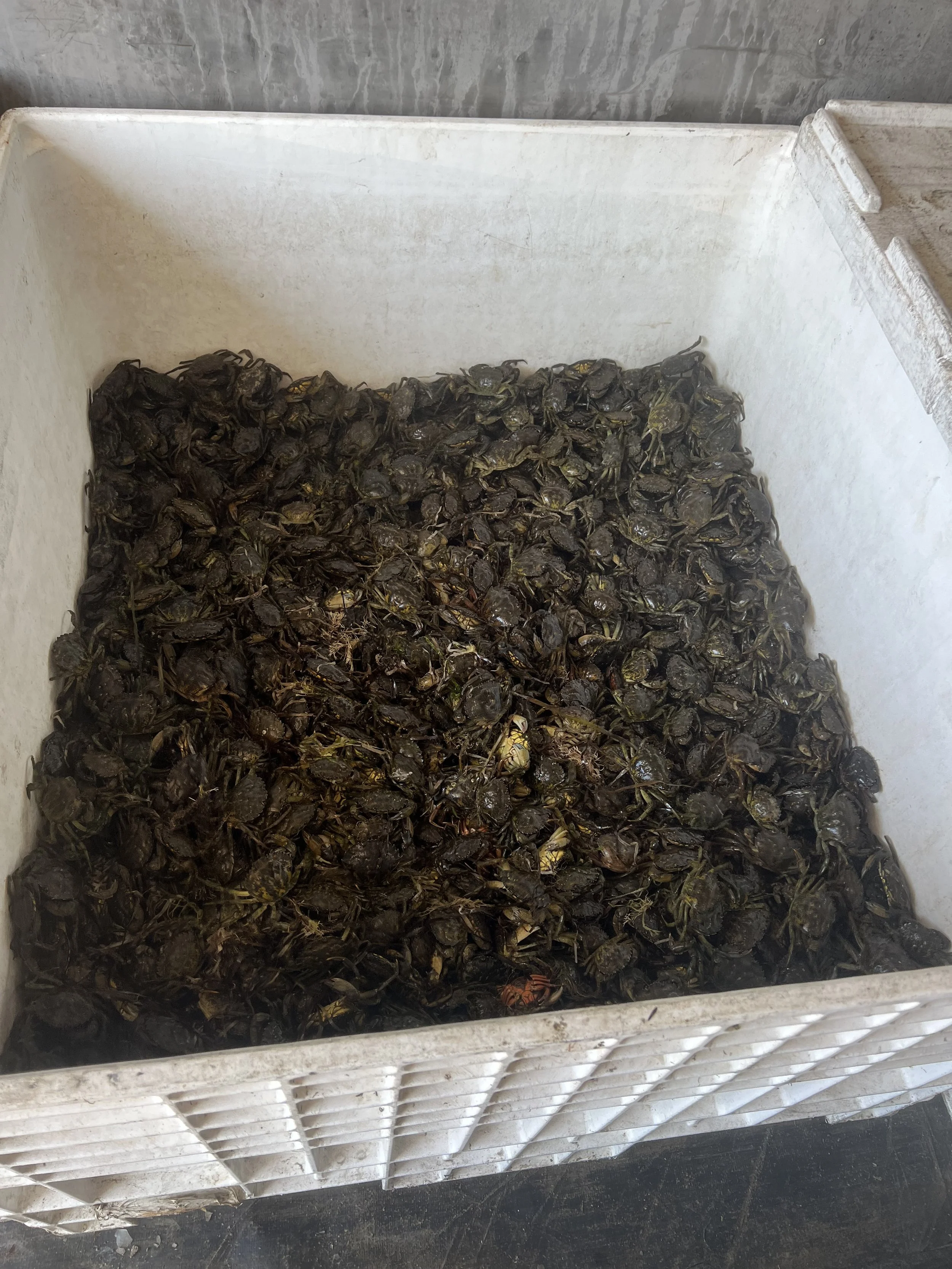
Tote of Green Crabs
Q: When were green crabs introduced to Haida Gwaii and when did you start trapping them?
Eli: Green crabs were first detected on Haida Gwaii in 2020. The Council of the Haida Nation took decisive action and started a green crab monitoring and depletion program with support of provincial and federal partners. At first, populations were quite small and seemingly manageable. This proved to be short-lived as populations expanded exponentially.
I established Haida Gwaii Marine Solutions in 2023 and began trapping them the same year. 2023 was also the year that the green crab population began to explode. Some locations in Skidegate Inlet, where I reside, had so many crabs that the ocean floor almost looked like it was crawling. The Haida Nation had to scale up the efficiency of the program to account for the large influx of crabs in 2023, including upgrading the disposal system to a large freezer capable of fitting multiple fish totes and lowering the data-taking requirements for trappers.
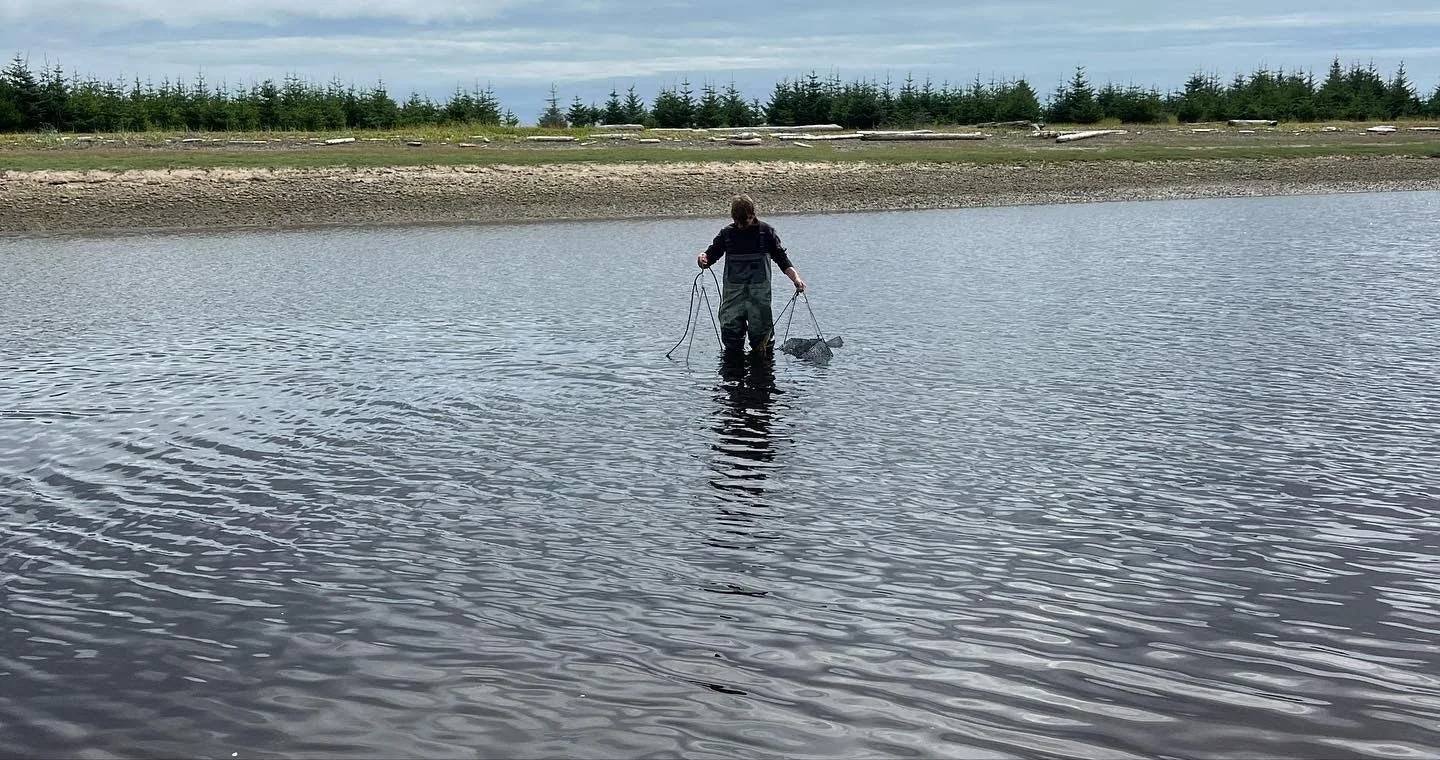
Pulling traps in the Tlell River, photo by Eli Gladstone
How have you been involved in the Council of the Haida Nation’s trapping program?
Eli: I have been involved in the Council of the Haida Nation’s trapping program as part of Haida Gwaii Marine Solutions, contracted for green crab trapping and research, along with various other small contractors since 2023. Between 2020 and 2025, 1.85 million crabs were trapped for the program. We have done depletion trapping where the goal is to kill as many crabs as possible in an area, as well as detection trapping to determine new areas of invasion. As of 2026, the public funding for the program has expired and there is minimal trapping being done.
What bait and traps do you use to catch green crabs?
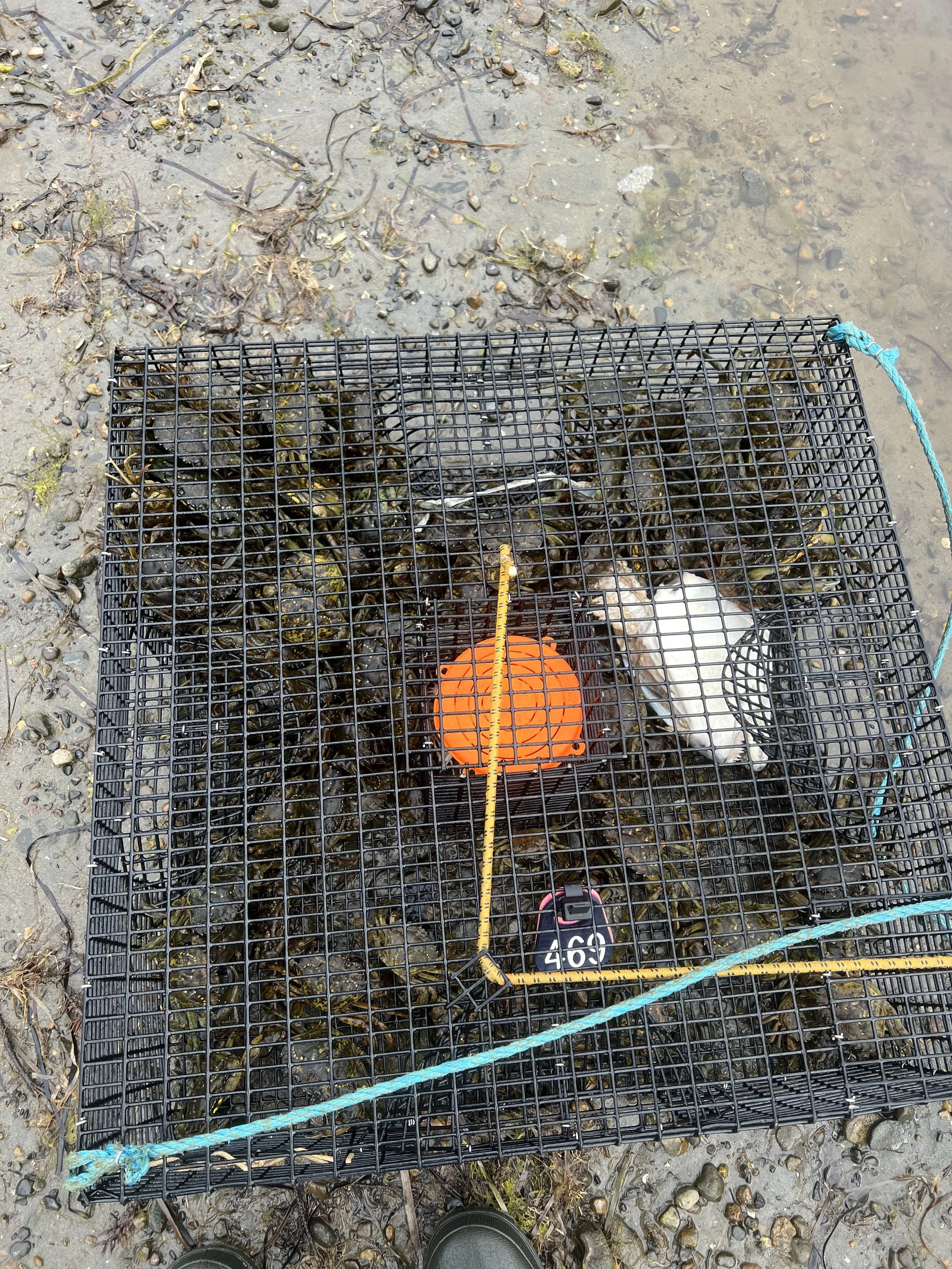
Eli: To catch green crabs we generally use either Fukui traps or Bauer traps. Bauer traps tend to catch more crabs; however, they do not fold and are quite bulky. Fukui traps are foldable and are far easier to transport. We have spent a lot of time trapping in a river called Tlell. There we always used Bauer traps as we were able to use a truck and trailer to transport them and set them by hand. When setting out of a small skiff or travelling long distances by water, we almost exclusively use Fukui traps since they fold and take up far less space. For example, ten Fukui traps folded take up a similar amount of space to one Bauer trap.
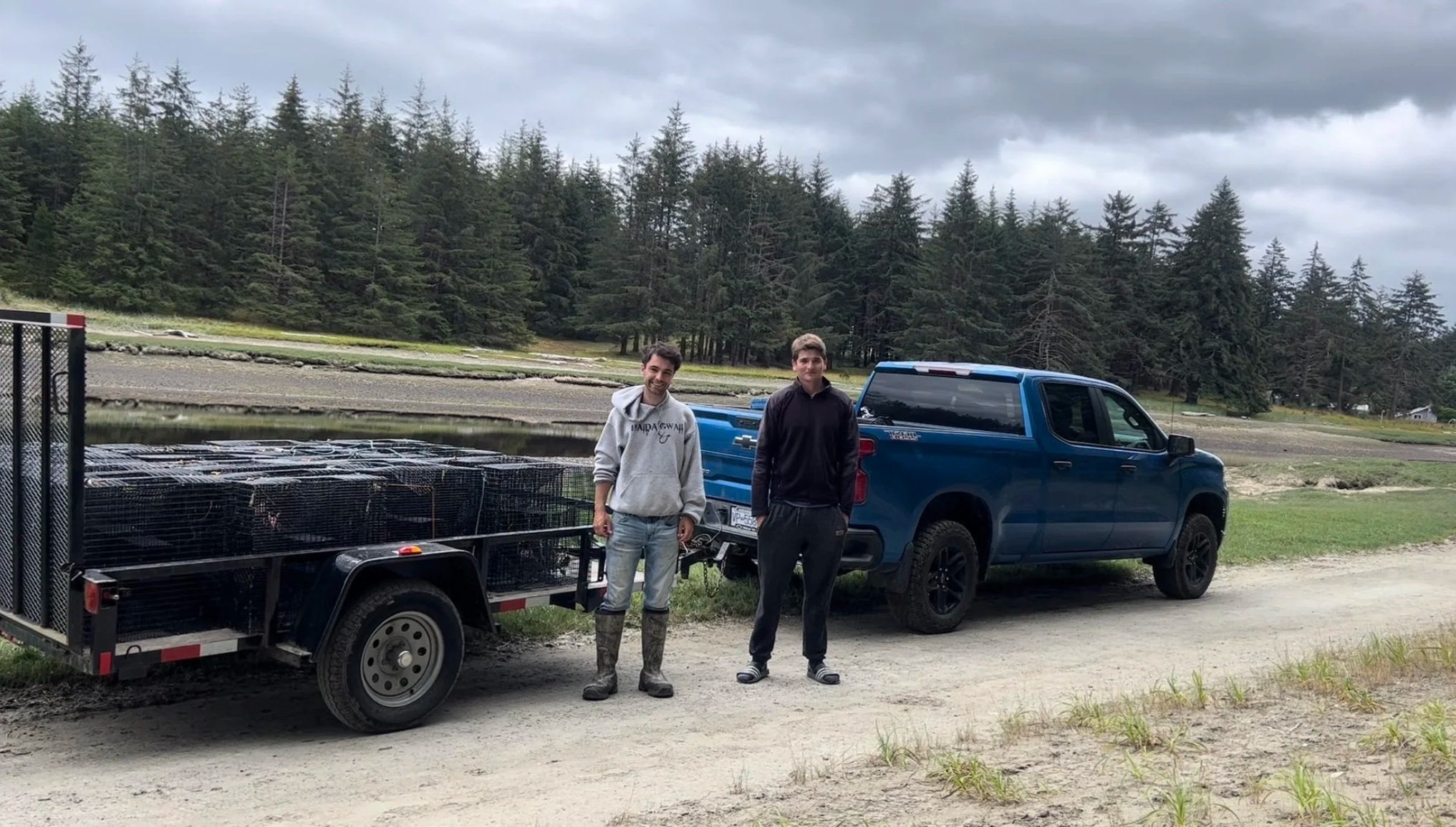
Eli Gladstone (left) and Linden McDiarmid (right) removing traps from the Tlell River
What’s handpicking and when would you use this method compared to traditional traps?
Eli: Handpicking involves foraging for crabs on the beach and picking them up individually rather than setting baited traps. Crabs are generally found under rocks and buried in sand. This method is used when harvesting in harsh ocean conditions where traps would be damaged, when targeting females (including gravid females), or when attempting to gain a better understanding of the crab population in the area.
Handpicking is less biased than trapping as trapping tends to catch a disproportionately high number of large males when populations are high, likely due to their aggression. Handpicking is more representative of the actual population. Handpicking also allows us to target gravid females, which are less active and often buried in sand. While handpicking, I have had days where I’ve collected over 100 gravid females in less than two hours.
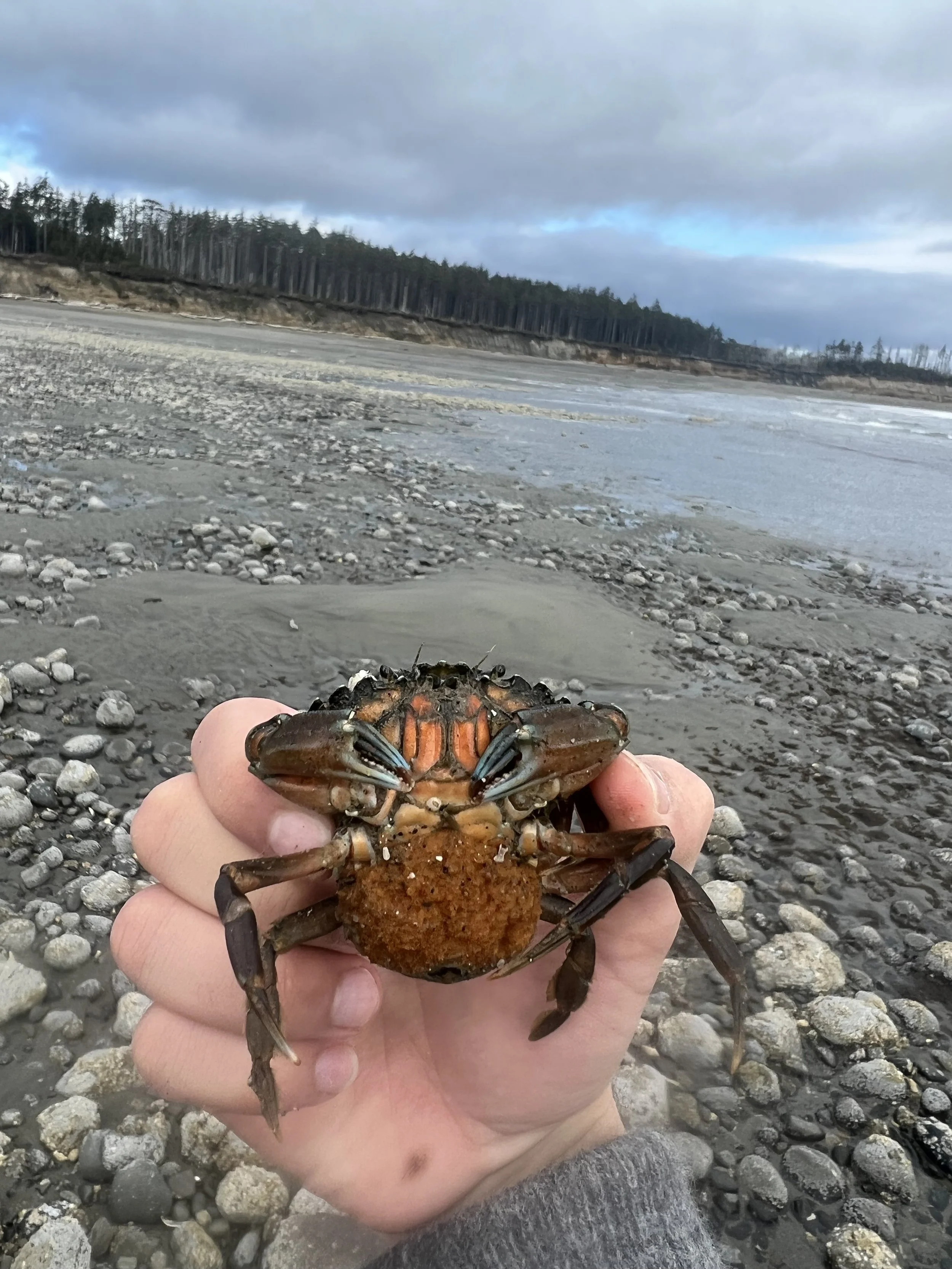
Gravid female
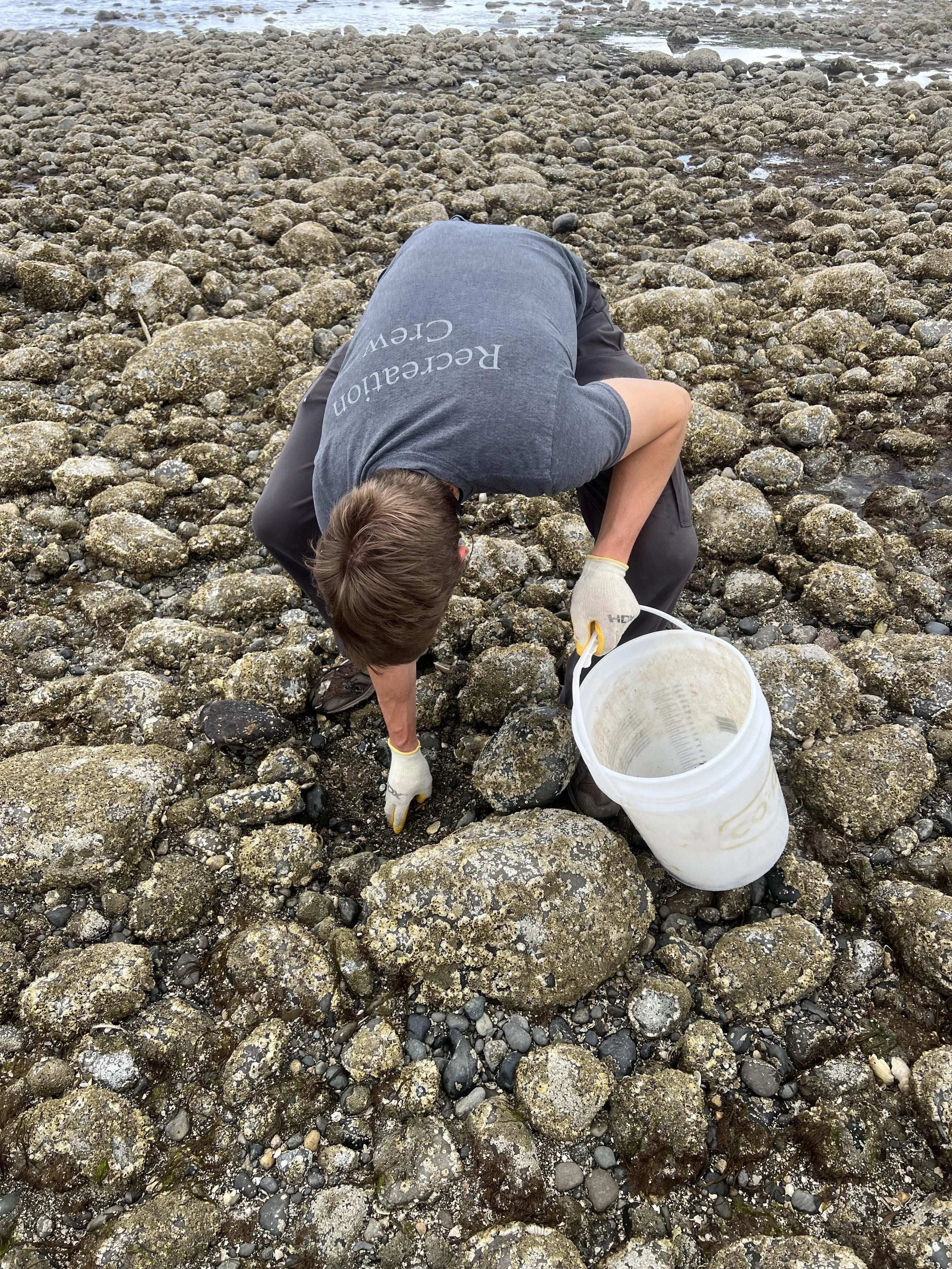
Handpicking green crabs
What are some other species you harvest in addition to green crabs? Could green crabs impact any of these species?
Eli: In addition to green crabs I harvest all species of Pacific salmon, Pacific halibut, herring, Dungeness crabs, giant Pacific octopus, and various shellfish. All of these species are very important food sources for the people of Haida Gwaii.
Green crabs could very much impact all of these species. Green crabs destroy eelgrass habitat, which is very important to juvenile salmon and herring, the latter of which is a very important food source for both salmon and halibut. I observed green crabs eating salmon out of gillnets during a traditional food fishery. Green crabs also reside in the same habitat as juvenile dungeness crabs and likely have a negative impact on them. We have observed evidence of octopus eating green crab therefore, it is unclear whether the net impact to octopus is positive or negative. Lastly, as has been observed in New England, green crabs can have a devastating impact on shellfish, especially soft shell clams.
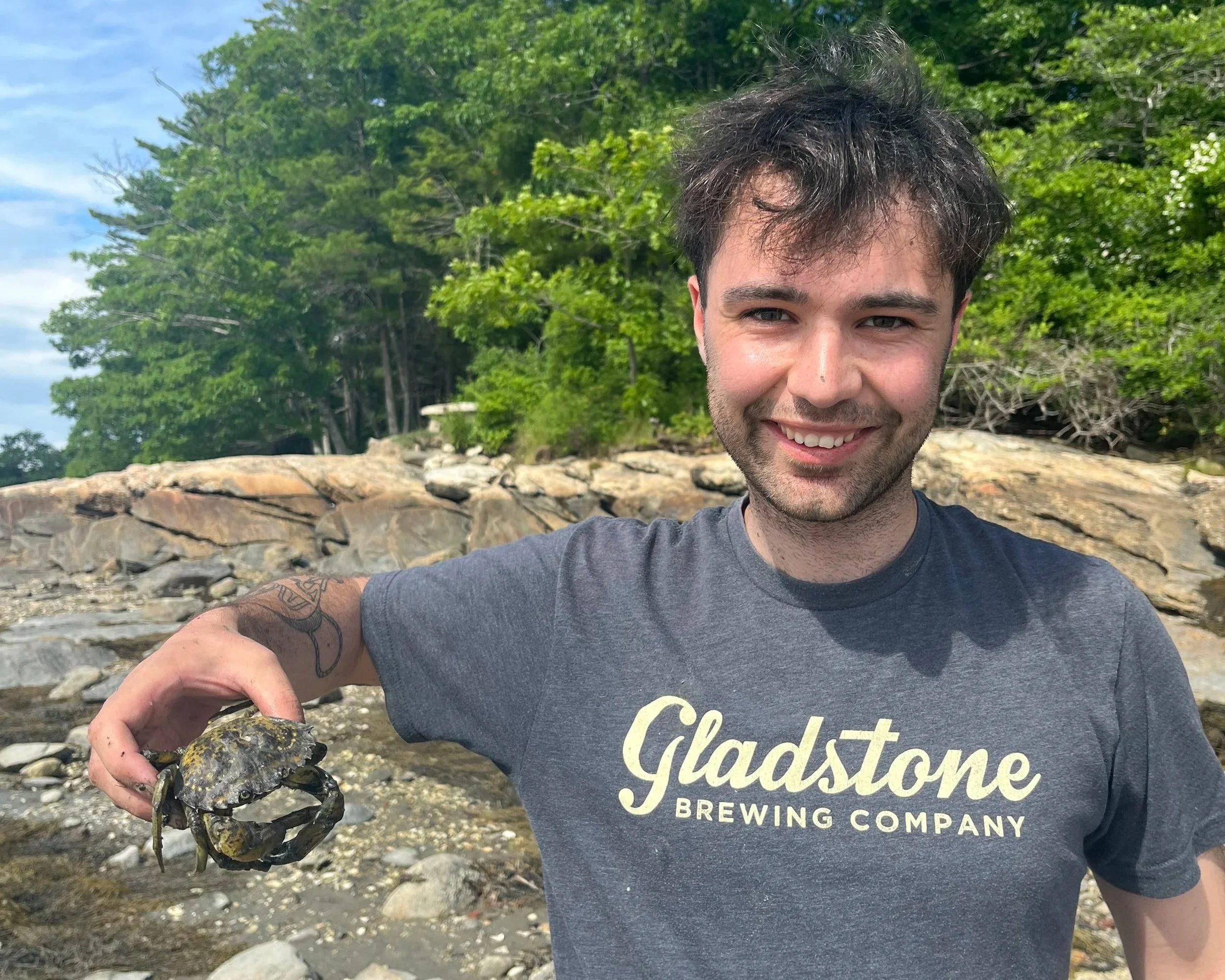
Eli took home the gold at the 2026 Green Crab Week Derby in Freeport, ME
Can you commercially harvest green crabs on Haida Gwaii?
Eli: I believe that commercial harvest of green crabs is viable on Haida Gwaii. This however would require a lot of market development on all levels of the supply chain. I am very excited to be looking into a two-day test fishery with the Haida Nation in the near future. The goal of this fishery is to determine the costs associated with harvesting, as well as the volume we could produce. This is not obvious from the Haida Nation’s green crab program as a lot of effort was put into taking extensive data. I will also be bringing a sample of crabs to a retail company in British Columbia next month. Although we are remote and shipping is costly, Haida Gwaii has a lot of experience trapping and can do so with great efficiency. In addition, Haida Gwaii is well known to many people around the world and with appropriate marketing, our product could have potential.
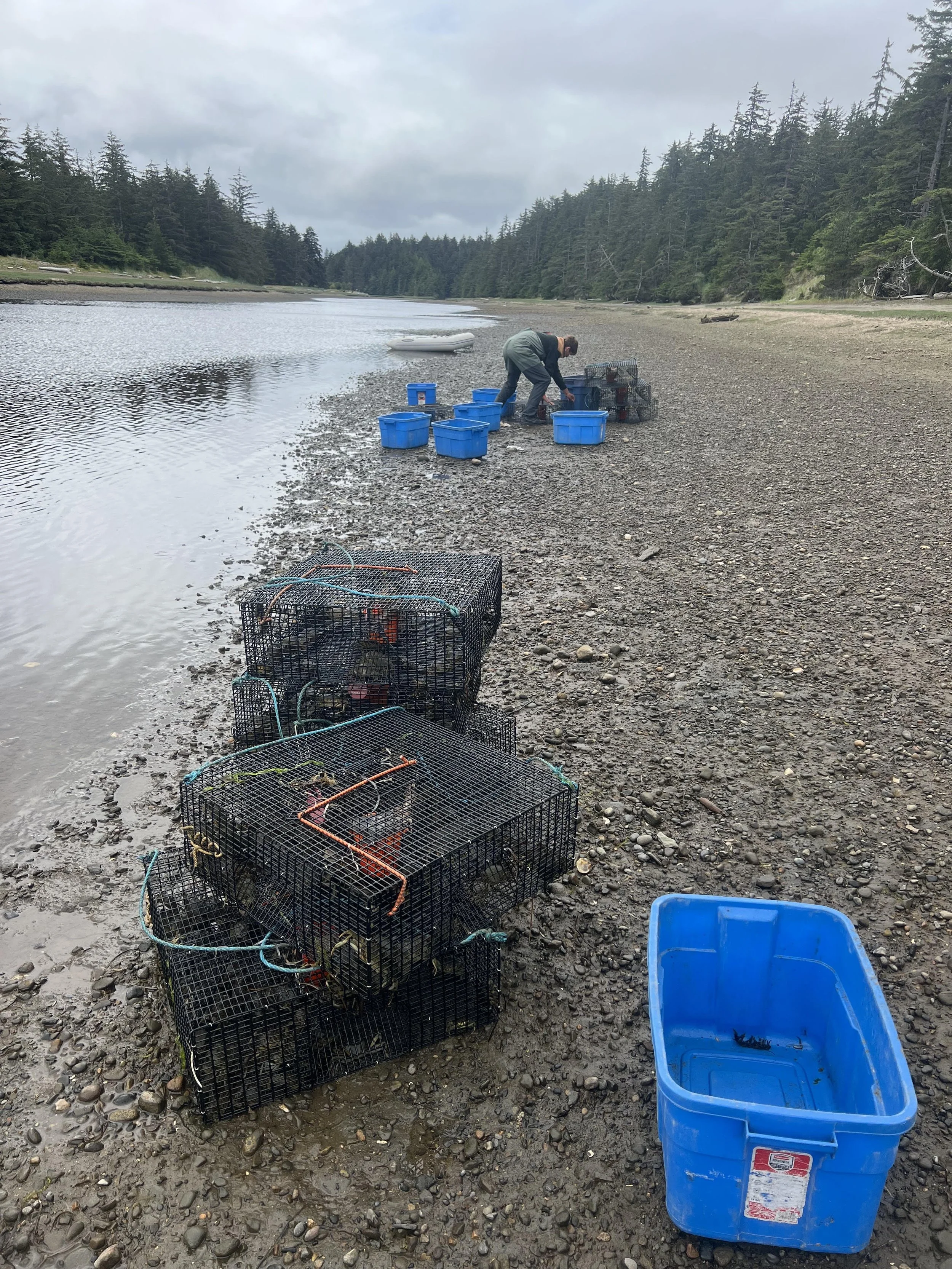
Emptying traps Tlell River
This past June, you had a chance to travel to Maine for the Green Crab Working Summit, where you shared your story as a green crabber on Haida Gwaii and learned about emerging markets on the West Coast. If a green crab fishery were to open in BC, what support systems would help you get your green crabs to market?
Eli: Attending the Green Crab Working Summit in Maine was an amazing learning experience. I am very grateful to Mary Parks and Greencrab.org as well as North American Marine Alliance, for making the travel possible, as well as for providing continued support in my green crab endeavors. I am also very grateful to everyone who attended the summit and shared valuable information from many perspectives.
My key takeaway was that green crab markets are possible and that they require extensive development from across the supply chain. Successful markets depend not only on harvesters, but also on processors, wholesalers, chefs, retailers, researchers, regulators, and consumers working together. The summit demonstrated how important it is to create connections between these groups and to share knowledge about harvesting, handling, processing, product development, and marketing.
I believe there is an opportunity to build similar support systems in British Columbia. A network or organization that could connect green crab harvesters with potential buyers, processors, chefs, seafood distributors, and researchers would be extremely valuable. Other important support systems could include processing and product development support, transportation support (especially for people operating in remote areas such as Haida Gwaii), chef and consumer education, data sharing between researchers, and small-scale pilot funding for all.
The Green Crab Working Summit showed me that building a market is not something that individual harvesters can accomplish on their own. It requires collaboration and a support network capable of bringing together the different pieces needed to move green crab from “problem to plate”. I think developing that kind of network in BC could be an important step toward creating economic opportunities while supporting efforts to address the impacts of this invasive species.
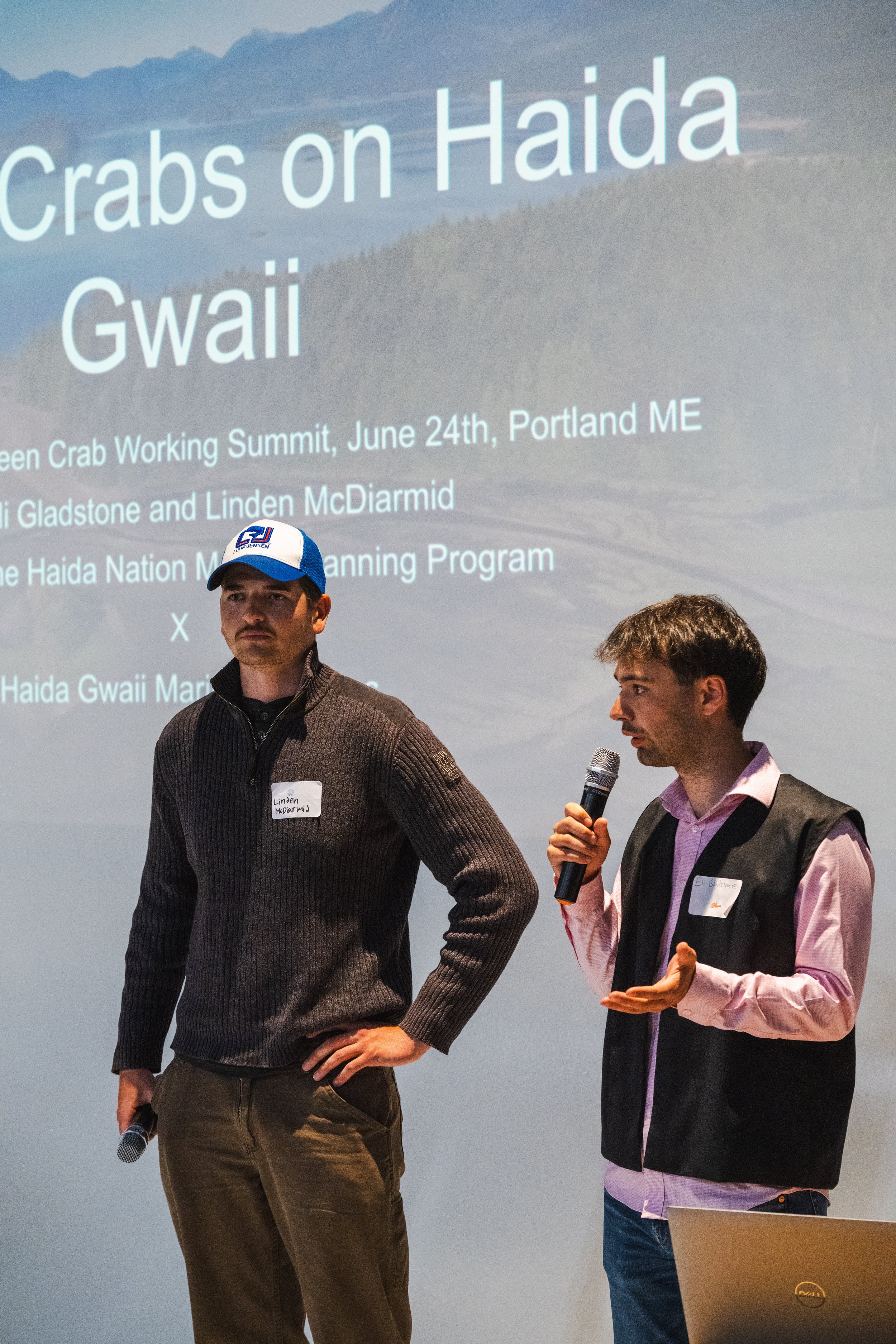
Eli Gladstone and Linden McDiarmid at the 2026 Green Crab Working Summit during Green Crab Week
Photo by Tim Briggs